Putin’s many defeats
Russian refineries are burning, Crimea is under logistical siege, and Moscow’s advance is moving towards net zero. The war has entered a new phase. Ukraine has the initiative

Russia is losing the war across every dimension that matters: military, industrial, economic, and political. Russia’s defeat should be measured less by daily movements along the front than by the widening gap between Putin’s original objectives and the war he has actually produced. Putin wanted Ukraine disarmed and subordinated to his imperial project. Instead, he now faces a country that produces millions of drones, develops long-range missiles, integrates its defense industry with Europe’s, and strikes deep inside the Russian Federation with surprising ease.
He wanted Crimea to be the showcase of Russia’s imperial revival. Instead, he has a peninsula under a state of emergency, increasingly cut off from Moscow, difficult to supply and defend, and less and less useful as a military and logistical platform in the Black Sea.
He wanted to prove that Western cohesion would collapse in the face of a reborn Russian empire. Instead, he faces a Europe that is slow and contradictory, to be sure, and now effectively divided from the United States, but still there. Reality is forcing Europe to understand that Kyiv has become an indispensable pillar of security on the old continent.
Putin was confident that Russia could withstand Western economic sanctions. He is now having to reckon with Kyiv’s “military” sanctions: long-range Ukrainian strikes that hit refineries every day, hundreds, and in some cases thousands, of kilometers from the front, while bottlenecks in fuel production, distribution, and exports become increasingly visible.
The regime change Putin hoped to trigger by taking Kyiv “in three days” is now unthinkable, except through democratic elections that will choose Zelensky’s successor when the time comes, that is, after the war. In Moscow, by contrast, the war that was supposed to consolidate Putin’s power is beginning to erode its foundations.
Putin’s unsustainable numbers
After the failure of the “three-day blitz” and the Ukrainian counteroffensive, the front largely froze in 2023. From that point on, Russia adopted a brutal but intelligible strategic logic: Putin would trade men and equipment for territory at a pace that Kyiv and its allies could not sustain. Time, in this view, would work in Russia’s favour, especially after Trump’s election in the United States.
That calculation is now turning against Moscow. As Mick Ryan has argued, the ratio between Russia’s losses, human and material, and its territorial gains has long since become unsustainable. In 2025, Russia was sacrificing around 200 men, killed or wounded, for every square mile it captured. In the first five months of 2026, with net territorial gains now close to zero, Moscow suffered more than 9,600 losses per square mile, or over 3,700 per square kilometer.
Russia can absorb losses that any European democracy would find politically intolerable. But even Russia’s capacity to convert men into territory has limits. According to estimates by The Economist, Russia’s total losses now stand between 1.1 and 1.4 million killed and wounded. That means that as many as one in 25 Russian men aged 18 to 49 may have been killed or seriously wounded since the beginning of the war.
The war effort is putting sustained pressure on factors of production, labor and capital. That pressure is making resource allocation increasingly inefficient and, together with the energy crisis triggered by Ukrainian strikes on refineries, is contributing to rising prices and slowing industrial production.
Ukraine, by contrast, has used Western support to build a domestic production capacity that now covers a growing share of its military needs. Those needs are structurally higher than those of the rest of Europe, because Ukraine is fighting a large-scale invasion on its own territory.
Ukraine seizes the initiative
Ukraine is no longer merely the country that resists. It is now imposing rising costs on Russia far beyond the front line.
According to the Institute for the Study of War (ISW), the conflict has entered a new phase, defined by the combination of Ukrainian medium- and long-range strikes and the return of mechanized manoeuvre. Russia’s average daily advance fell from 13.2 square kilometers in 2025 to 2.9 in the first four months of 2026. Current Russian gains are in the range of 3 to 5 square kilometers a day. In April, Russia recorded a net loss of 116 square kilometers, bringing its gains close to net zero despite the enormous losses described above.
Part of the shift is technological. Ukrainian drones combine low cost, long range, assisted guidance, and Starlink connections that make them less vulnerable to Russian electronic warfare. Russian military bloggers, often more candid than official propaganda when addressing their own side, acknowledge that it will take months to develop the capacity to neutralize the Ukrainian drone threat.
According to ISW, drone air superiority has also enabled Ukraine to resume mechanized advances. Near Oleksandrivka, in the Donetsk region, along the axis linking the Donbas to the Zaporizhzhia and Dnipropetrovsk fronts, Ukrainian armored vehicles pushed up to 19 kilometers behind Russian lines, forcing Moscow to pull back elite units. On the Kinburn Peninsula, a narrow strip of land at the mouth of the Dnipro-Bug estuary between the Black Sea, Mykolaiv, and Kherson, ISW has reported signs of Russian withdrawal from some positions. It attributes these signs to the growing difficulty of sustaining supply lines under Ukrainian pressure.
It is too early to say whether a strategic counteroffensive is beginning. But signs are multiplying that Ukraine is no longer simply “holding.” It has taken the initiative and is creating serious operational problems for the Russian command in several sectors.
Reading the war only by staring at the red line on a map of the Donbas is a mistake. It prevents us from understanding the dynamics of the conflict. Contemporary war is also fought by making rear areas unsafe, degrading the enemy’s sources of war financing, such as refineries, striking railways and depots, and forcing the aggressor to disperse air defenses to protect infrastructure that, until yesterday, did not need protection. On this terrain, Ukraine is no longer just taking blows. It is forcing the invader to defend itself, and to do so with great difficulty.
Russian oil is burning
Ukraine’s campaign against Russian oil infrastructure is one of the decisive transformations of the conflict. It will not collapse the Russian economy on its own. But it strikes at a central source of funding for the invader’s war effort.
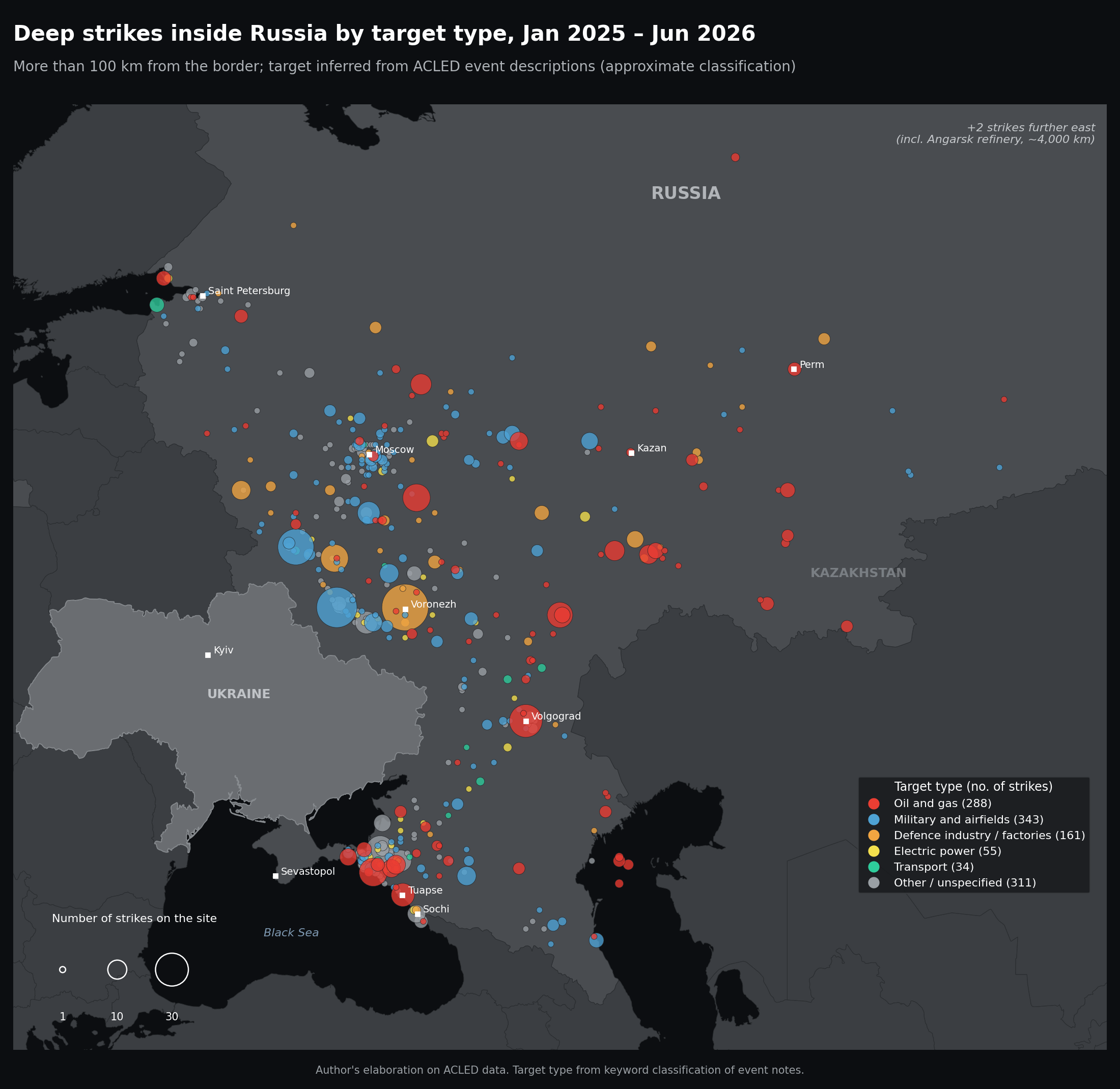
The Economist has shown the sharp increase in Ukrainian strikes on targets at least 100 kilometers from the border: refineries, logistics hubs, ammunition depots, and arms factories. In 2025 alone, there were 658 such attacks, compared with 335 in the previous three years combined. Between January and May 2026, deep strikes verified by ACLED, the Armed Conflict Location & Event Data project, had already reached 377, against 181 in the same period in 2025. Twenty-four of Russia’s 32 main refineries have been hit repeatedly, including those in the Moscow and St Petersburg areas, among the best protected in the Federation.
In the map below, I use ACLED data to show the distribution of deep strikes inside Russian territory. I have deliberately excluded border strikes, mostly concentrated in the Belgorod region to the south-east, because they are so numerous that they would make the map harder to read. A version including them appears in the postscript.
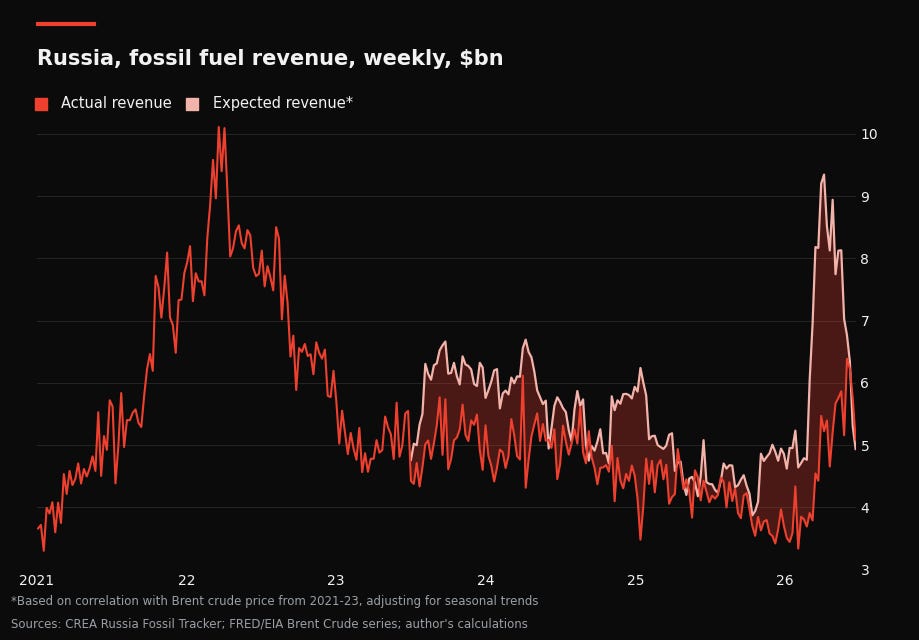
Russian refinery output has fallen by around 15% year on year, despite favorable prices. Revenues show the same pressure. Using CREA data, I estimate a counterfactual revenue path based on Brent crude prices. On that basis, Russian fossil-fuel revenues fell 12% below the implied level between June and December 2025, a shortfall of about $17 billion. In the first four months of 2026, the estimated gap rises to roughly 36%.
The chart below compares, week by week, the revenues Russia actually earns from oil and gas exports, in red, with the revenues it should earn given the price of crude, in the lighter line. When the red line falls below the lighter one, Moscow is earning less than expected. Actual revenues come from CREA’s Russia Fossil Tracker. Expected revenues are produced through a simple calculation linking historical revenues to the Brent price, using FRED/EIA data and accounting for seasonality.
According to Ukrainian economist Tymofiy Mylovanov, president of the Kyiv School of Economics, Russian refining has fallen to a 21-year low, below the level reached during the 2009 crisis. Capacity has dropped from 5.2 to less than 4 million barrels per day. Unleaded petrol is up by around 35%, and more than 20 regions have been forced into some form of rationing. Reuters reports that the Moscow refinery, repeatedly hit by drones, is expected to remain offline for at least six months and is unlikely to resume production before 2027.
The Russian response is revealing. The government continues to play down the problem, insisting that reserves are sufficient, that the difficulties reflect only minor logistical adjustments, and that export restrictions are temporary measures designed to stabilize the domestic market. But for a country whose oil exports are one of the main sources of war financing, reorganizing distribution, rationing sales, restricting exports, and explaining kilometers-long queues at petrol stations and rising prices creates serious logistical, military, financial, and political problems.
Crimea, from trophy to burden
Crimea is the most striking theatre of this reversal in the military initiative. For Putin, Crimea is not just another territory. It is a founding symbol of his imperial project after 2014: the place where Russia told itself that its lost greatness had returned, and one of the platforms from which the invasion of southern Ukraine was launched in 2022. In the regime’s narrative, Crimea was supposed to prove that history had started moving again in Moscow’s direction.
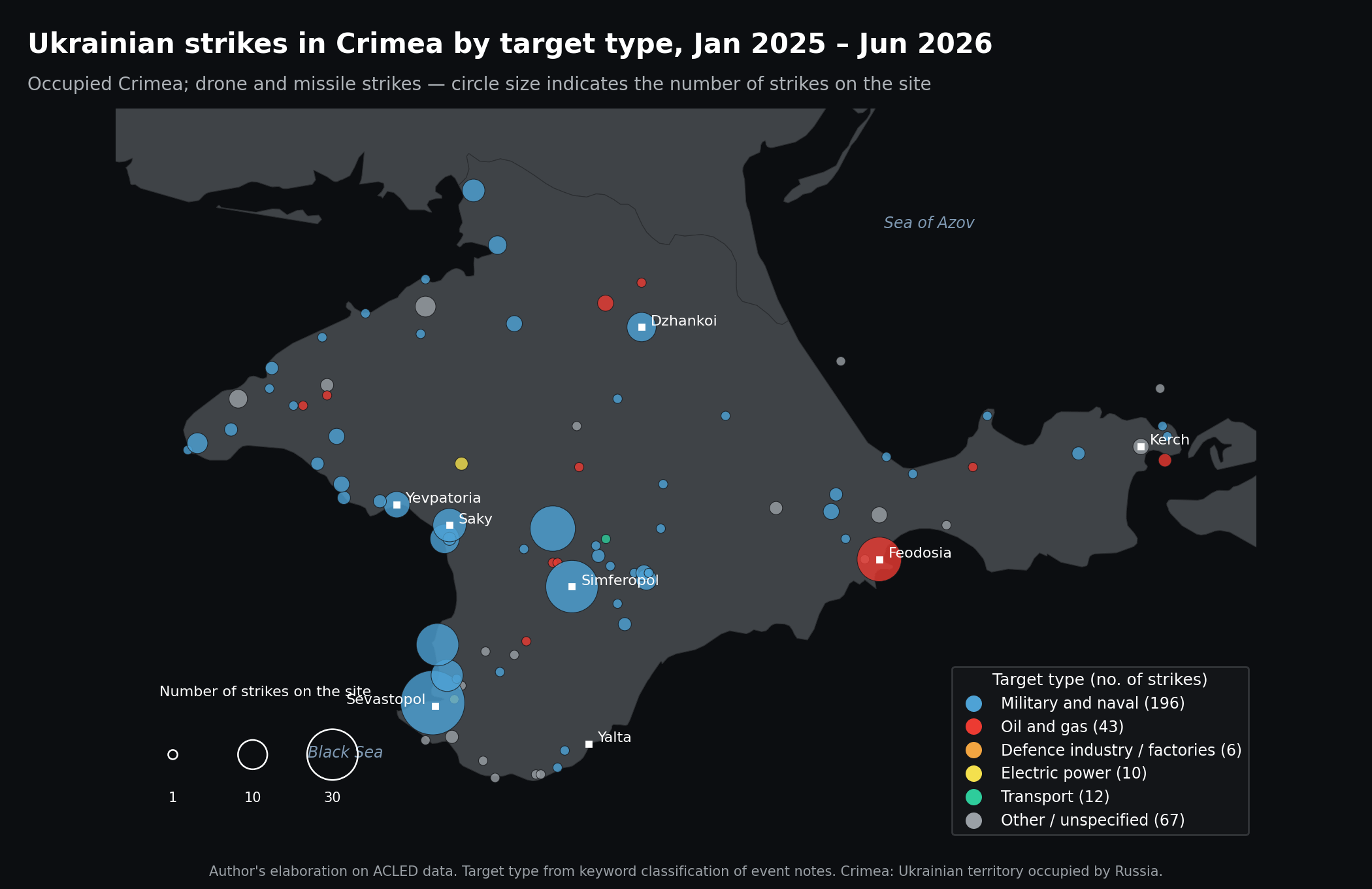
Today, Crimea is becoming a source of vulnerability for Russia. According to the Wall Street Journal (WSJ), the peninsula has become a burden for Putin. The occupation authorities have declared a state of emergency to manage the fuel, energy, transport, and logistics crisis caused by Ukrainian attacks. The WSJ describes a Ukrainian campaign involving more than 100 drone attacks a day, disrupting logistics, transport, and electricity infrastructure just as the tourist season was beginning, a crucial moment for the peninsula’s economy.
In the map below, I reconstruct Ukrainian drone strikes in Crimea over the past two months using ACLED data. The frequency appears lower than the figure reported by the WSJ because ACLED includes only attacks verified by multiple sources.
Alina Frolova, of Kyiv’s Center for Defense Strategies, describes the Crimea campaign as a classic isolation operation: cutting military supply routes and related infrastructure, often ahead of an offensive action.
After an initial phase of rationing, Russian authorities in Crimea banned the sale of fuel to civilians, with the remaining fuel redirected to critical infrastructure. The WSJ reports food shortages, ATMs running out of cash, shop closures, blackouts, household water cuts, and mobile-network outages in several parts of the peninsula.
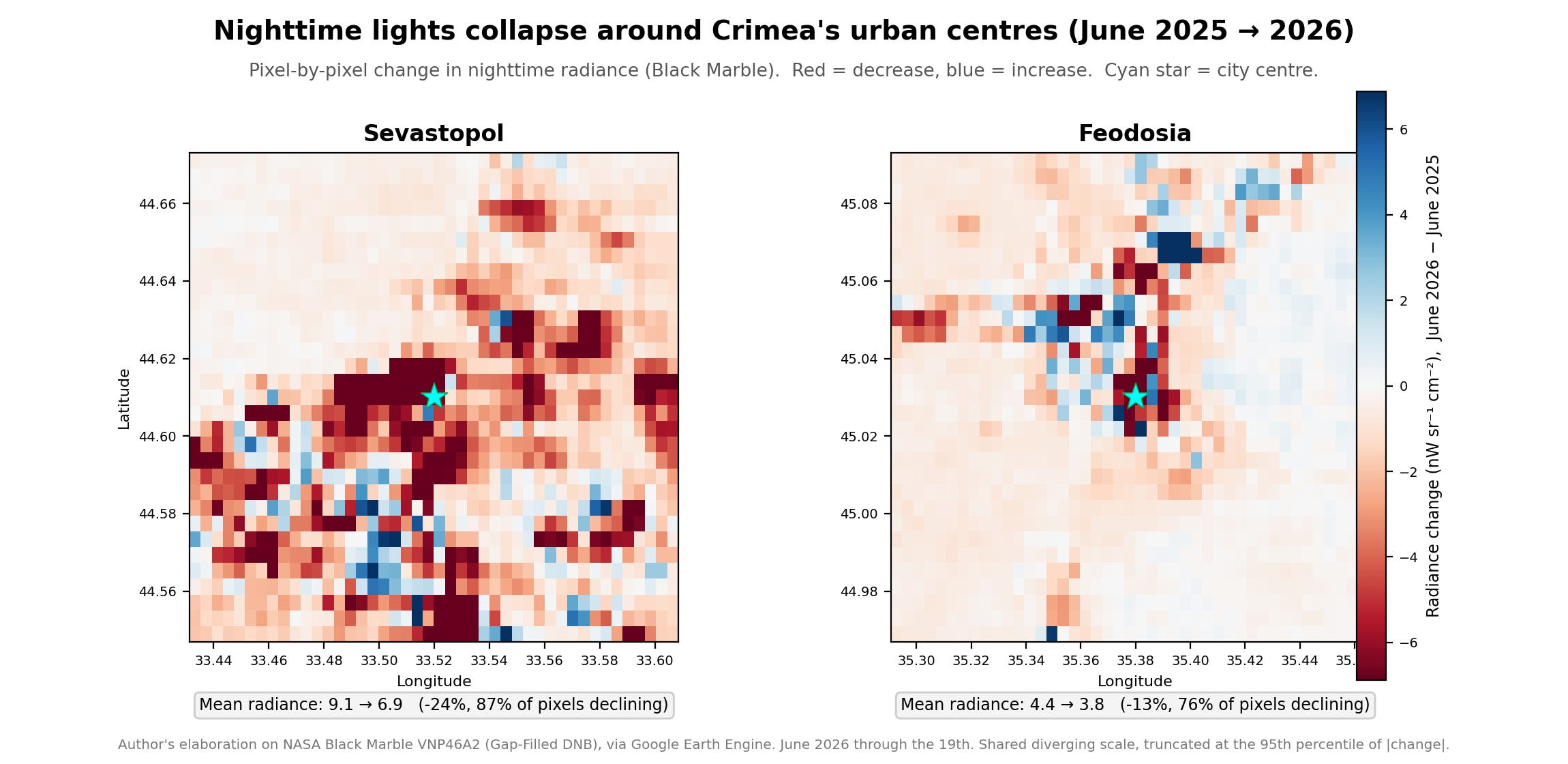
In the figure below, I use observations from the Suomi-NPP satellite, processed through NASA’s Black Marble product, to show the decline in Crimea’s night-time lights from space. Each square is a pixel of roughly half a kilometers. Red marks areas where night-time light decreased between June 2025 and June 2026; blue marks areas where it increased; the light-blue star identifies the city center. In Sevastopol, the base of Russia’s Black Sea Fleet, 86% of pixels have darkened, with average radiance down 22%. In Feodosia, three quarters of pixels are in decline. I compare the same month across two consecutive years precisely to avoid confusing this decline with normal seasonal variation in lighting. It is a trace, measurable from Earth orbit, of the logistical and energy crisis that Ukrainian attacks are producing on the peninsula.
The Kerch Bridge is the most visible symbol of this transformation. It is one of the few major lines of communication that Ukraine has so far spared. After the attacks of 25–26 June, ISW reported around 2,450 vehicles queued on the Kerch side, heading towards Russia, with no queues in the opposite direction. Civilian cars are lining up to leave the peninsula. This is hardly the image of a territory stably absorbed into Russian normality. To be clear, this is not an orderly withdrawal of the Russian presence. Rather, the peninsula appears to have entered a dynamic of outflow, rationing, and logistical isolation, while Russia can no longer reliably supply or defend it.
The logistical siege of Crimea could affect the internal dynamics of the Russian regime. The first parliamentary elections since the start of the full-scale invasion are only a few months away. The vote will be tightly controlled and does not truly threaten Putin’s power. But the campaign season heightens the regime’s political sensitivity. A Crimea under a state of emergency, with fuel shortages and tourists fleeing, is a symbolic problem before it is a military one.
Crimea is unlikely to fall in the coming months. But its symbolic transformation has already taken place. The peninsula that was supposed to certify the regime’s imperial strength now shows the world Russia’s vulnerability.
The cognitive war is shifting
The wind is also turning in the cognitive war. For years, Russian propaganda, in the talk-show version that has shaped Italian public opinion on the conflict, revolved around a single claim: Putin’s victory was inevitable. From that premise followed all the familiar corollaries: that any military support for Ukraine would only prolong its suffering, and that realism required a peace agreement amounting, in substance, to Ukrainian surrender.
Although this narrative has built a loyal audience in Italy, it is becoming harder and harder to sustain. Explaining the inevitability of Russian victory while Crimea declares a state of emergency, Russian refining and oil exports come under pressure, and Russia’s advance moves towards net zero now requires ever greater feats of imagination, and shamelessness.
Zelensky’s diplomatic initiative, which took the form of an open letter to Putin on 4 June, should be read in this light. As Nathalie Tocci has observed, Kyiv is using not only resilience and drones, but also diplomacy, to shift the cognitive balance of the war. Zelensky’s willingness to discuss a freeze along the current line of contact is not an act of surrender. It is a way of forcing Putin to confront his own contradiction: if Moscow wants peace, it can stop; if it refuses, it becomes increasingly clear that the war continues because the Russian regime does not know how to live without war.
ISW has reported that the Kremlin continues to reject Ukrainian offers of direct negotiations, while trying to present itself as the reasonable party by clinging to alleged understandings with the United States that were never turned into public agreements. On 26 June, Lavrov tried to blame the Americans for the failure to reach an agreement after the 2025 bilateral summit in Alaska. The tactic is always the same: claim to want peace while rejecting the minimum conditions for discussing it seriously.
Lessons for Europe
With all its delays, fragilities, and uncertainties, Europe is learning a few lessons. The first concerns the need to build a European defense architecture that does not depend on the United States. As I documented in my post “Who supports Ukrainian resistance,” in 2025 the Trump administration all but cut off aid to Ukraine, and almost all economic, humanitarian, and military assistance now comes from the European Union and the rest of Europe. This transition has not led to Ukraine’s collapse, as Putin and MAGA hawks had hoped. On the contrary, the Russian invader is under growing pressure.
The second lesson is that Ukraine is no longer merely a beneficiary of European security. It has become one of its main producers. It has fought the most intense conventional war on the continent since 1945. It has developed military innovation capabilities that many NATO armies study with a mixture of admiration and embarrassment. It has built a drone supply chain while Europe is still discussing one in strategy papers. It has shown that a young and imperfect democracy, attacked by a nuclear power, can resist, at enormous cost, without becoming a satellite state of its aggressor.
Recognizing these facts does not mean idealizing Kyiv. Democracies at war remain fragile, and we cannot predict how Ukraine’s political trajectory will evolve after the conflict. But any European defense architecture born in this new phase of US disengagement will have to include Ukraine not as a periphery to be protected, but as a military and industrial pillar of the continent. Democratic Europe is both strong and fragile. It must finally recognize that, if it wants to acquire the capacity to defend itself, it needs Ukraine at least as much as Ukraine needs Europe.
Epilogue
Given a scenario that has become unexpectedly unfavorable for Moscow, many are asking whether Putin’s regime could collapse. I would like the answer to be yes. But that would be wishful thinking. External pressure can wear Russia down, make the war more costly, and damage its revenues and prestige. By itself, however, it is unlikely to bring Putin down.
As Andrei Soldatov wrote in the Observer, contemporary Russia has been built to prevent popular discontent from becoming political change. Society has been pushed towards apathy and disengagement. Street revolts are now almost unthinkable, because for years even the smallest public expressions of dissent have been met with immediate arrest. When power has wavered in recent Russian history, it has done so because of fractures within the armed elites, the military, and the security apparatus.
Ukraine’s campaigns of deep strikes inside Russian territory and the isolation of Crimea, however, can also increase internal pressure. They show that the regime is not invulnerable, that the war is not going as promised, and that remaining tied to Putin’s fate may become costly.
On 24 February 2022, one of Putin’s stated objectives was regime change in Kyiv: Zelensky was supposed to fall within days, making way for a Russian protectorate disguised as a government. Four years later, regime change in Kyiv looks even less likely than regime change in Moscow. The war that was supposed to change Ukraine’s government may end up opening a crisis of the Russian regime.
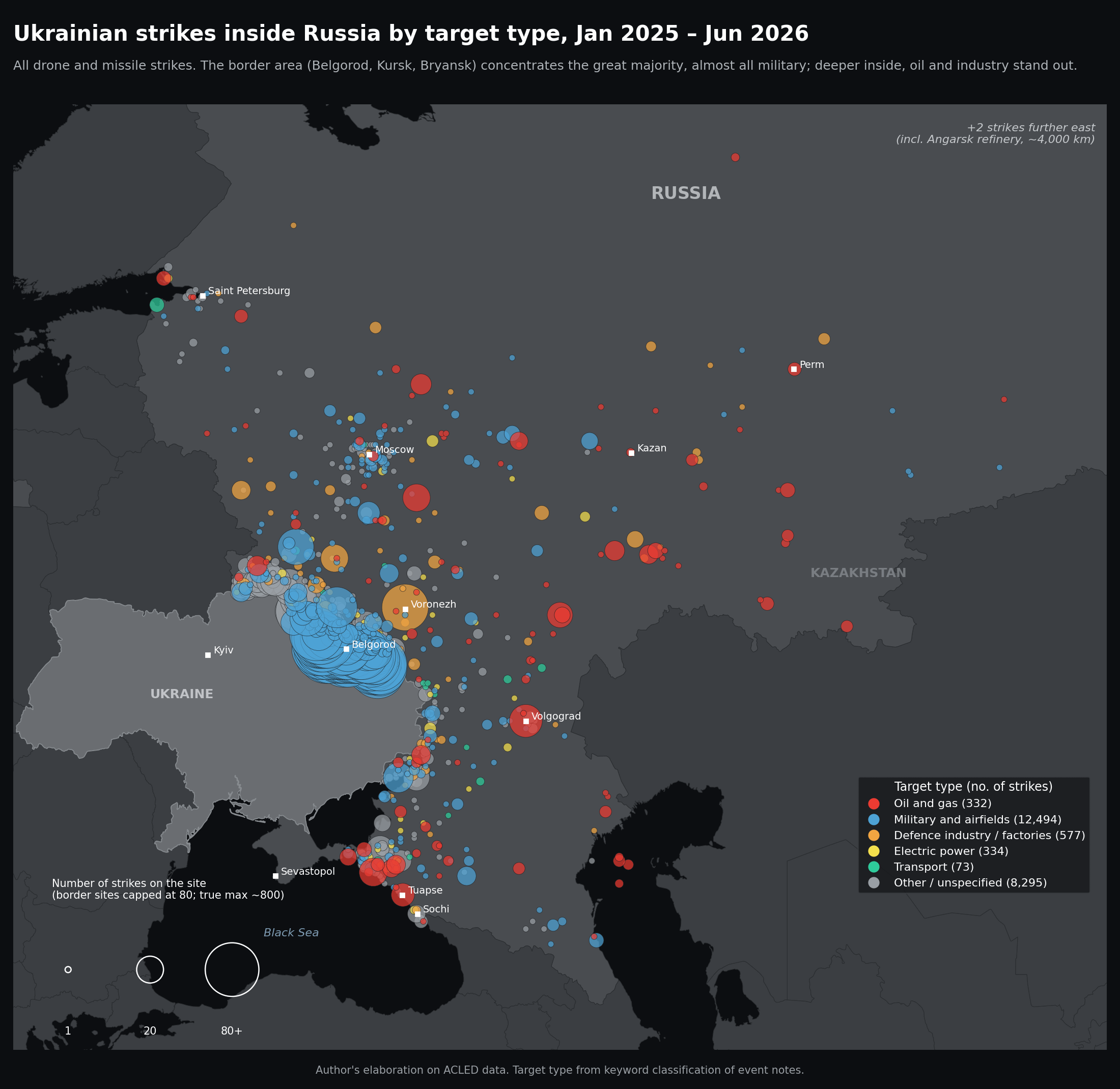
PS: This map uses ACLED data to show Ukrainian drone and missile strikes, including those in Russia’s border regions.